
Software we run ourselves – built for your business.
Web apps, iOS and Android apps, AI integration, automation and servers from a single source. What you read here runs in production for our own business – on servers in Germany.
From our own operations
Measured live · as of 11/05/2026, 11:41 PM
2,170
Linux servers provisioned automatically
and torn down again, since May 2026 (Techlogia Lab)
56 s
from click to ready server
average of the last 30 days
Web apps
We build web applications from the database to the interface: customer portals, internal tools, admin areas, learning platforms.
See it in the Techlogia Lab
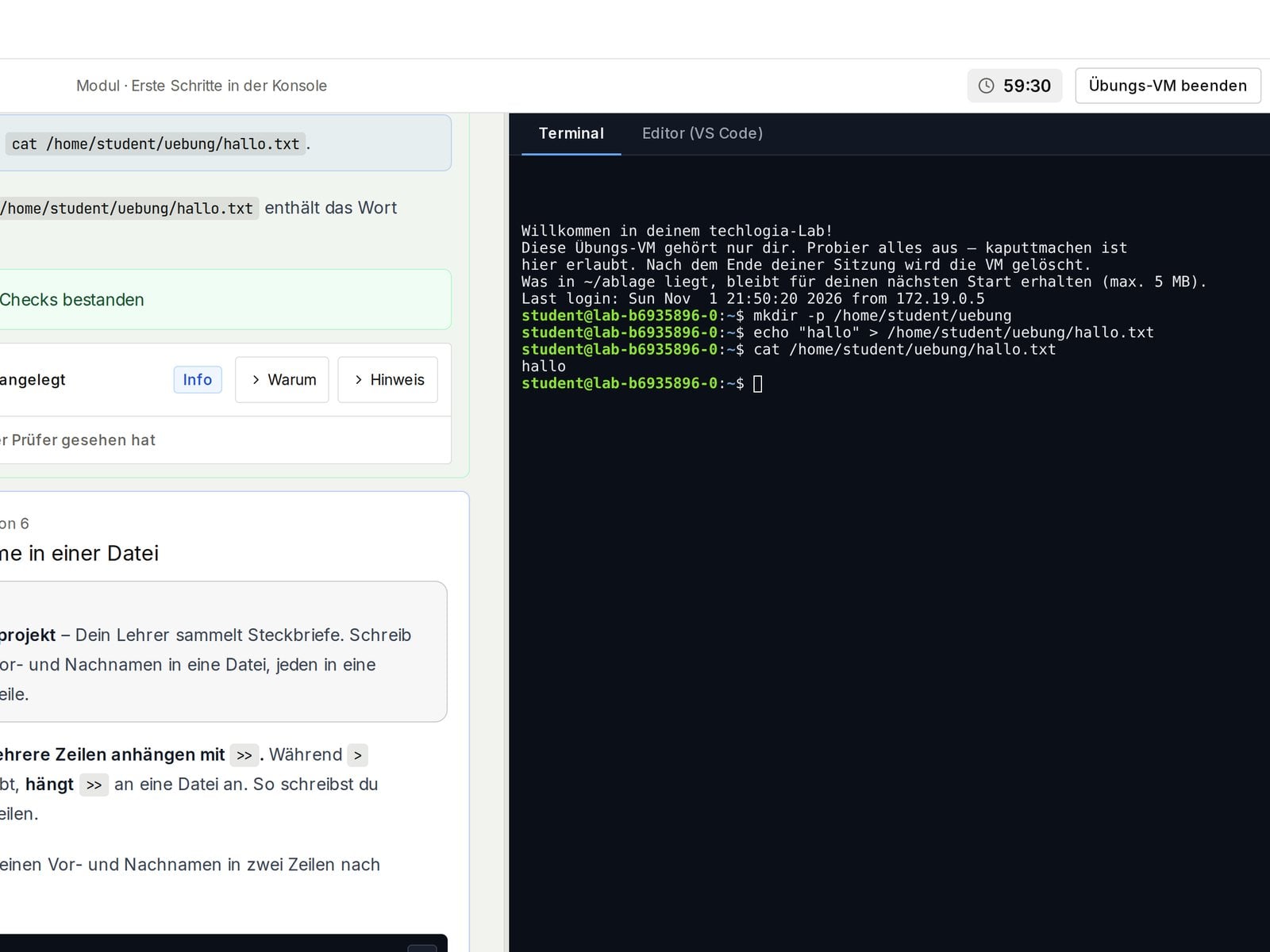
A learning platform where every lesson starts a real Linux VM in the browser. A checker reads the state of the machine and tells you within seconds what is still missing.
Typical projects
- Customer portal with login, roles and GDPR-compliant data export
- Internal tool that replaces an overgrown Excel spreadsheet
- Admin area where your team maintains content without a developer
Tech: Next.js, React, TypeScript, FastAPI, MariaDB, Redis, Docker
Apps for iOS and Android
We build apps that talk to your backend, don't crash on a weak connection and pass App Store review.
In the App Store: the Techlogia app
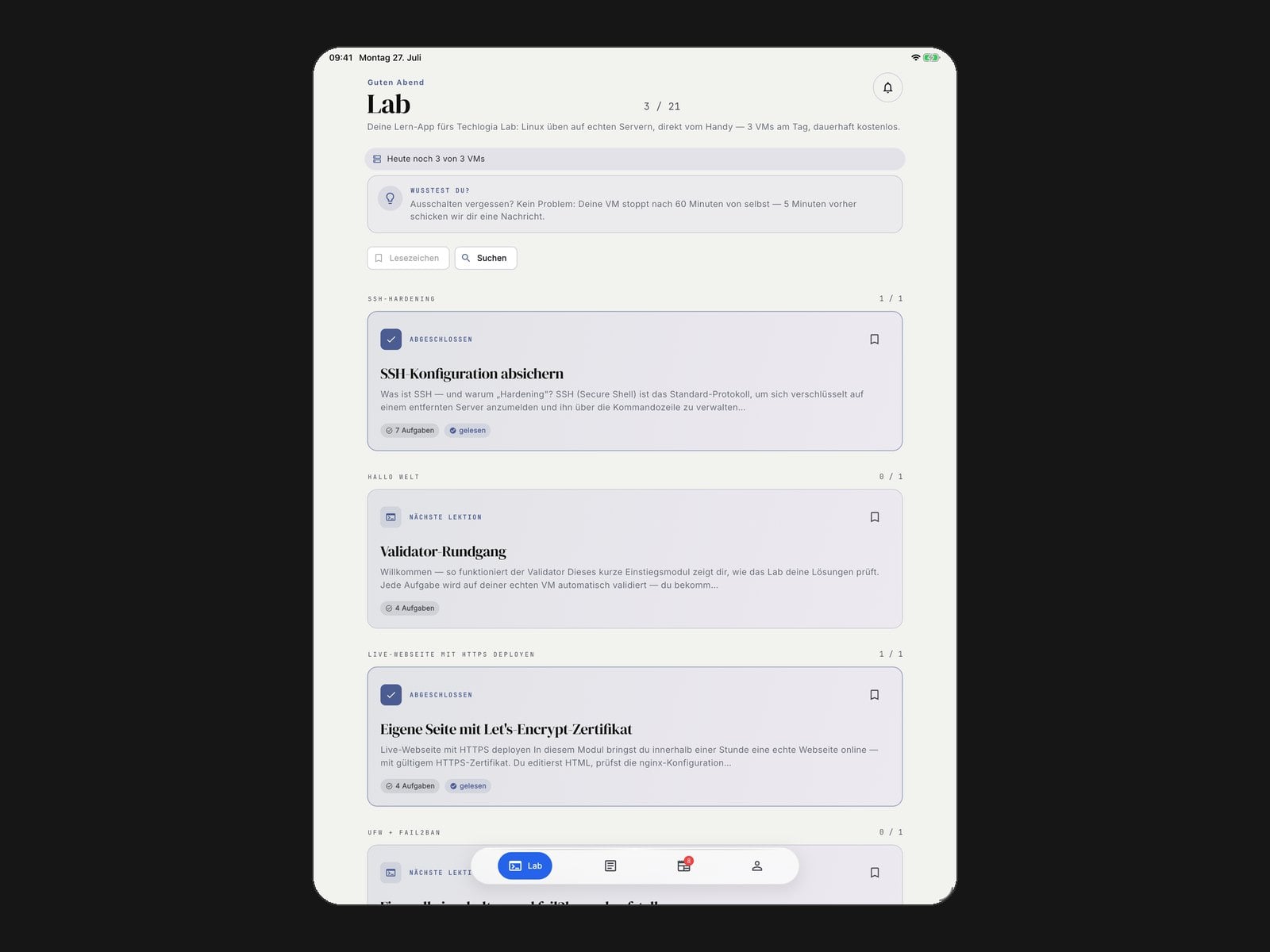
Lessons, progress, notifications and a terminal to the Lab VM. Built with Flutter and connected to the same API as the website.
Typical projects
- Companion app for an existing web platform
- Field service app that records data offline and syncs later
- Publishing on the App Store and Google Play, including store review
Tech: Flutter, Dart, push notifications, crash reports on our own server
AI integration
We bring in language models where they take work off your team – and leave them out where a simple rule will do.
In our own use
The open-source project Dreamline gives AI assistants a long-term memory (MIT license, source code public). In our own bookkeeping, a Claude model reads receipts and suggests the booking – confirmation is done by hand. Before every tax filing, it checks the figures for anything unusual.
Typical projects
- Assistant that answers from your own documents
- Automatically sort incoming receipts and emails
- On request with models on your own servers, so data stays in-house
Tech: Claude API, Python, Paperless-ngx
- Your data
- Servers in Germany or on your premises. Your content is not used to train third-party models.
- Test first, then build
- A short trial with your real documents shows whether AI pays off before you invest in a project.
- No lock-in
- The model can be swapped without rebuilding the application.
Automation and deployments
We automate what would otherwise be done by hand: workflows between your programs, rollouts of new versions and backups.
How it runs for us
New versions of our platform only go live through a release gate: automated tests against the real database, the test environment first, then production.
Typical projects
- n8n workflow: receipts from the inbox straight into accounting
- Deployments with automated tests instead of manual uploads
- Encrypted off-site backups with a rehearsed restore
Tech: n8n, Docker, OpenTofu, restic
- Your team can change it
- n8n workflows are visible and can be adjusted without programming skills.
- Operated in Germany
- On your own server instead of a US service.
Servers and networks
Running software means running the machines underneath it. We set up servers, harden and monitor them, and make sure a restore isn't rehearsed for the first time on the day of an outage.
How we run it ourselves
Separate networks for production and testing at Hetzner in Germany, alerts on two channels, backups with regularly rehearsed restores.
Typical projects
- Setting up servers with a firewall and automatic security updates
- Monitoring with alerts by email and Telegram
- Encrypted backups with a documented restore path
Tech: Hetzner Cloud, Nginx, MariaDB, Prometheus, Grafana, Loki, restic
- What we don't do
- No hardware sales, no phone systems, no work on 230-volt installations.
- Where
- On site in Berlin and Brandenburg, remotely everywhere else.
How we work together
1. Conversation
You describe the problem. We tell you honestly whether and how we can help. Free of charge.
2. Concept
Scope, price and schedule in writing before anything is built.
3. Implementation
Interim versions to look at, tests from the start.
4. Operation
If you wish, we keep looking after the solution under a maintenance contract.
Two topics, at length
GDPR-compliant web applications
Where the data sits, who may see it, when it disappears — and how to prove that rather than promise it. With a case study from a regulated setting.
Read onSelf-hosted infrastructure
What self-hosting really costs, when it pays off and when it does not — including the items most comparisons leave out.
Read onAnswers about technology, hosting and collaboration
Have a project?
Tell us what it is about. In a first conversation we work out with you whether and how we can help – free and without obligation.